


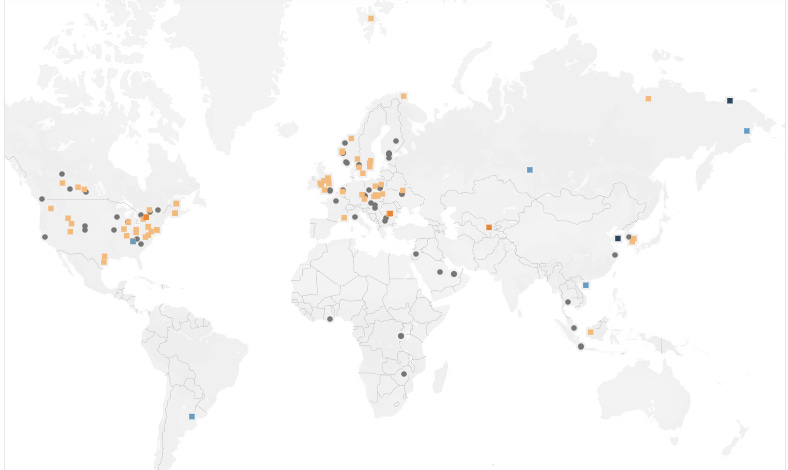
interactive map - Small Modular Reactor (SMR) Global Project Tracker in various stages of development - only 2 are operating so far - Russia and China - click here to see map and codes
As I was about to write about SMRs, Thomas Shepstone of Energy Security and Freedom posted a great piece by Duggan Flanagan that encompasses the broader picture that includes the US promotion of all types of nuclear power plants.
The Department of Energy’s Reactor Pilot Program, which is fast-tracking the testing of advanced reactor designs, selected 10 companies…to reach criticality (a state where nuclear fission reactions become stable and self-sustaining)…[these include] include Aalo Atomics Inc., Antares Nuclear Inc., Atomic Alchemy Inc., Deep Fission Inc., Last Energy Inc., Oklo Inc. (two projects), Natura Resources LLC., Radiant Industries Inc., Terrestrial Energy Inc., and Valar Atomics Inc.
I asked chatgpt to define the terms being used:
1) Small Modular Reactor (SMR)
A small modular reactor (SMR) is a nuclear fission power reactor that:
Produces up to about 300 megawatts electric (MWe) per unit
Is factory-built in modules and shipped to a site for assembly
Is designed for lower upfront cost and scalable deployment (adding multiple units as needed)
Most SMRs are light-water reactors, similar in basic physics to today’s large plants, but smaller and often with enhanced passive safety systems.
Examples:
NuScale Power VOYGR SMR
GE Hitachi Nuclear Energy BWRX-300
Rolls-Royce SMR design
Key idea: Smaller, factory-built versions of traditional nuclear plants.
2) Microreactor
A microreactor is an even smaller nuclear reactor, typically:
Producing 1–20 MWe (sometimes defined up to ~50 MWe)
Designed for remote sites, military bases, mining operations, or isolated grids
Often capable of operating for years without refueling
Microreactors emphasize:
Transportability (truck, rail, or barge delivery)
Minimal on-site staffing
Very long fuel cycles
Examples:
Oklo Inc. Aurora
Westinghouse Electric Company eVinci
BWX Technologies microreactor projects
Key idea: Portable, very small nuclear generators for niche or remote applications.
3) Advanced Reactor
An advanced reactor is a broader category referring to non-traditional reactor designs that differ significantly from today’s conventional light-water reactors.
They may use:
Different coolants (liquid sodium, molten salt, helium gas, lead)
Different fuel types (HALEU, TRISO, metallic fuel, molten fuel)
Alternative safety approaches (strong passive safety, low pressure systems)
“Advanced” refers more to technology type than size. An advanced reactor could be:
Large
An SMR
Or a microreactor
Examples:
TerraPower (sodium-cooled Natrium reactor)
X-energy (high-temperature gas reactor)
Kairos Power (fluoride salt–cooled reactor)
Key idea: Refers to next-generation nuclear designs, not necessarily smaller ones.
most of these projects are too early to tell if they’re economically viable
Optimistically, the iea.org said about a year ago “…many small modular reactor (SMR) designs are under development; the first commercial SMR projects are set to start operation around 2030.”
More recently, iaea.org, said ~ 80 SMR designs and concepts globally, are not ready for commercial scale. Some are claimed as being near-term deployable.”
chatGPT:
SMRs currently operating
1. Akademik Lomonosov — Russia
This is a floating nuclear power plant in the Russian Far East (near Pevek) that has been commercially generating electricity since about 2020.
It uses two small reactors (~35 MW each) to provide power (and heat) for the local grid and community.
2. China’s HTR-PM SMR
China has connected its HTR-PM (a modular pebble-bed high-temperature gas-cooled reactor) to the grid and is producing electricity as of 2021.
So globally, only these very few SMRs are actually running and supplying electricity — and they’re not the mass-market commercial fleet that many SMR advocates talk about.
🚫 *Other SMRs are not yet operating commercially
Most SMR designs are still in development, regulatory review, or early construction phases (e.g., Canada’s upcoming BWRX-300 project at Darlington, expected ~2030).
In places like the U.S., no SMR has yet begun commercial power production. Regulatory approvals exist (e.g., one design approved), but no plant is generating power yet.
from Energy Bad Boys 1/17/26
Robert Bryce did a paywalled report on the significant downturn in the stock valuations of publicly traded Small Modular Reactor (SMR) companies during November. Bryce’s SMR Intelligence Update #3 analyzes the stock performance of Oklo, NuScale Power, Terrestrial Energy, and Nano Nuclear Energy, highlighting the substantial losses experienced by these pure-play SMR firms.
In addition to the stock market analysis, Bryce’s update covers Britain’s decision to select Rolls-Royce plc’s SMR for deployment in Wales. It also includes a brief Q&A featuring Liz Muller’s pitch for Deep on the video , providing insights into this company’s approach to SMR technology and deployment. The update aims to keep subscribers informed about key developments in the rapidly evolving SMR sector.
Rapidly evolving? What does that mean?
Here’s one idea - putting the small modular reactor a mile deep! deep fission video, deepfission.com
Energy Security and Freedom did a guest post last December, expressing high hopes for SMRs:
South Africa expects to lift the care and maintenance status of its Pebble Bed Modular Reactor (PBMR) by the first quarter of next year or even earlier. Alternative sources of stable, continuous electricity, in this instance provided by SMR units, will benefit as environmental trends increasingly move towards green technologies. These technologies, because of cost and price trends, will become increasingly economic and cost-effective in the future. That remains to be seen…
A comprehensive economic impact study of South Africa’s small modular reactor (SMR) deployment strategy,…reveals what is at stake when developing nations pursue practical electricity solutions that can generate continuous, uninterrupted, and emission-free electricity. The findings offer a compelling blueprint for how SMR technology could transform not just electricity access, but entire economies.
It could, but will it?
WNN (World Nuclear News) - The South African Pebble Bed Modular Reactor (PBMR) [a Generation IV, helium-cooled, high-temperature nuclear reactor designed to use TRISO-coated fuel particles embedded in graphite spheres (pebbles)]. Developed since 1993 for efficient, safe, small-scale power generation, the project was halted in 2010 due to funding shortages but is currently seeing a revival, with efforts to bring a 100 MW design to market within five years.
WNN 12/3/25 “The US Department of Energy has selected Tennessee Valley Authority and Holtec to each receive USD400 million in federal cost-shared funding to support early deployments of advanced light-water small modular reactors in the USA.”
WNN 11/25 “Molten salt reactor developer Thorizon announced it has secured broad industrial and regional support in the Netherlands for the construction of Thorizon Pioneer, a nuclear demonstrator for next-generation molten-salt reactors.”
Still way in future - 2030 for construction -of a demonstrator; not commercial!
The Czech Republic's ÚJV Řež has signed a memorandum of understanding with UK-based Rolls-Royce SMR "aimed at deepening further cooperation in the implementation of small modular reactor technology in the Czech Republic and abroad". The MoU will see the companies “explore opportunities across a range of technical and regulatory areas, including nuclear safety analysis, design and engineering services, evaluation and testing, technical support to operations, licensing and regulatory requirements specific to the Czech Republic”. Rolls-Royce SMR’s technology has been selected by the Czech Republic to provide up to 3 GW of capacity in the country with nuclear power plant operator ČEZ, which has also taken a 20% stake in Rolls-Royce SMR.”
WNN 11/25 https://world-nuclear-news.org/articles/equinix-signs-up-for-power-from-first-stellaria-reactor?
French molten salt reactor developer Stellaria has signed a pre-order agreement with data centre developer and operator Equinix. Under the agreement, Equinix has secured the first power capacity reservation on the Stellarium, the reactor that Stellaria plans to deploy starting in 2035. Stellarium, the first Breed and Burn reactor covered by the pre-order agreement (Image: Stellaria)
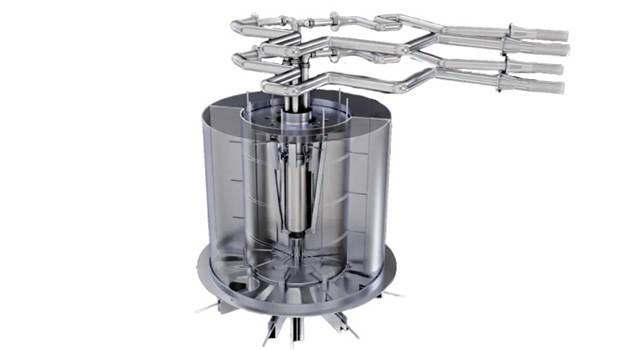
The agreement between Stellaria and Equinix is part of several Equinix initiatives in the field of alternative energy. In August, the company announced collaborations with five energy providers, including Stellaria in France, to support the growth of its AI-ready data centres. The Stellarium reactor proposed by Stellaria - a spin-off from the French Alternative Energies and Atomic Energy Commission (CEA) - will be very compact (measuring 4 cubic metres) and will be able to use a diversified range of nuclear fuels (uranium, plutonium, MOX, minor actinides, even thorium). Stellaria says the reactor is “the world’s first reactor to operate with a liquid fuel capable of destroying more waste than it produces”.
“Kyrgyzstan is exploring the possibility of building its first nuclear power plant using Russian small modular reactors, Vladimir Putin has said.”
“Rosatom is implementing a large-scale reclamation programme for uranium mining sites. The possibility of constructing the republic’s first nuclear power plant using advanced Russian small modular reactor technologies is being explored. These reactors, I emphasise, meet the most stringent safety and environmental protection requirements,” he [Putin] said.”
conclusion: It’s still early, but we have high hopes! Nuclear power is the future, and small size units will be great if they succeed, but we also have very successful full-sized nuclear power plants that we know can work for as much as 100 years of 24/7 year round power - and finally we’re going to start building them again!
I'm not a nuclear engineer but an electrical engineer but I can do math and I can look at the economics. I just don't see much hope for small module reactors. Any of them that use a fabrication of fuel that is not commercially available right now to me is going to be very expensive UP the front. The only real hope nuclear is to make it less expensive than or equivalent inexpense Coal. Factoring in 100 year life plus a high capacity factor of 90% plus might make nuclear cheap enough versus the front costs to regular commercial reactors of a large size of about gigawatt. Westinghouse AP1000 megawatt reactor seems too expensive. https://jackdevanney.substack.com/ == If you want the public to support nuclear, make it cheap
Al Christie presents good facts about nuclear power. That is different from writers who have little or no experience in nuclear power. They describe a future that is far from what experience has shown to be practical and safe, like the whole world on nuclear power in 50 or 100 years, and nuclear power saving the world from the supposed pollutant, man-made carbon dioxide. I worked in commercial nuclear power in the USA and Switzerland (where I learned a lot). Also learned a lot from the French nuclear power program. Later, I had the privilege to get to know the hands-on pioneering experts in fast breeder reactors. Bill Gates and others didn't listen to them about the incompetence and the anti-advanced-nuclear-power bias embedded in the DOE by Obama's Science Advisor, John Holdren, an acquaintance of mine since 1970.